Welcome to Iraq - my 109th Full
Member UN Country (193 Total) !!!
In this post I fly from Beirut in Lebanon to
Baghdad in Iraq and visit the city of Baghdad with 12 other travellers, our
driver Ahmed, our leader Katie and our two local guides Jousef and Ibrahim, all
part of the Rocky Road Travel company dedicated to tours of countries that most
people may not want to visit…
Baghdad (Pop 8,126,755, Elev 34m, Founded 762AD)
is the largest city and capital of Iraq and the second-largest city in the Arab
world after Cairo. It is located on the Tigris near the ruins of the ancient
Akkadian city of Babylon and the Sassanid Persian capital of Ctesiphon. In 762
CE, Baghdad was chosen as the capital of the Abbasid Caliphate, and became its
most notable major development project. Within a short time, the city evolved
into a significant cultural, commercial, and intellectual centre of the Muslim
world.
The city was largely destroyed at the hands of
the Mongol Empire in 1258, resulting in a decline that would linger through
many centuries due to frequent plagues and multiple successive empires.
Baghdad Airport is old but in reasonable shape.
My Greek Passport Visa was issued in 30min and for USD77. My driver was nowhere
to be seen. I was sent a photo of him. Eventually I found him and we were off
to the city centre some 22km away. Baghdad is very spread out, very yellowy
brown, dusty dirty and full of low-rise concrete apartments with antennas on
them. It looks like a city in the Middle East or even some places in Africa. It
is hot and dry. Our hotel was built in 2005, only 2 years before the US attack and
quite nice and one of the few places where all the media lived. My fellow
travellers were out touring and arrived around 5pm. I met them all – definitely
an overall older crowd than the Syrian group. Only two Aussies – myself and a
guy from Perth. I met Christina from my Syria trip (only the two of us did both
trips). In all we had 2 Ozzies, 2 Germans, 2 Scotts, 1 Englishman, 2 NZ, 1
Canadian and 2 from the US of A.
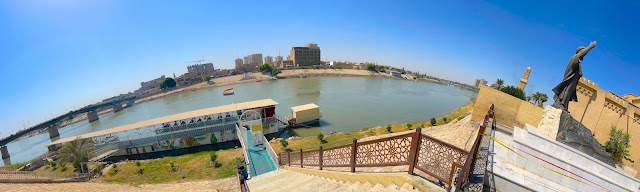
We had our first dinner at a huge half-local,
half-touristy restaurant right on the Tigris River and with Tigris prices too
considering this was meant to be Iraq with a deflated currency. The local
dishes are very heavy on bread and meat and rice. Not many veggies at all. I
had a dish called Arayes which is pitta bread stuffed with spiced minced beef
(see photo) – 8 pieces for AUD20 with not much meat inside. No chips. No salad.
A bit of a rip.
The very next day I ran 10km in a city that was
bombed to pieces in 2007. Hard to believe. At 630am the temperature is a cool
22C and everyone is on the streets buying and delivering stuff before it gets
too hot. We all set out at 0845 to visit the following sites in the city: Al-Shaheed
Monument (Martyr's Memorial), Mustansiriya Madrasah School, Old Town Streets
& Souk, Tigris River, Shabinder Café.
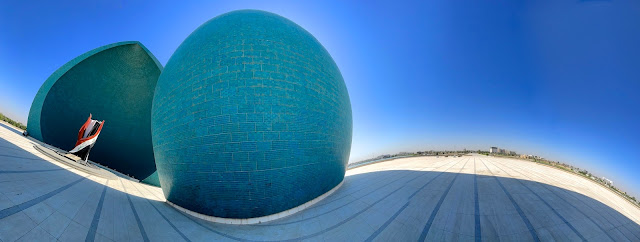
The Martyr's Memorial comprises two huge 40
metre high tiled water droplets surrounding a flame in the colours of the Iraqi
flag that is dedicated to the Iraqi soldiers who died in the Iran–Iraq War. The
whole thing is surrounded by an artificial lake and took 3 years to built and
opened in 1983.
The Mustansiriya Madrasah was a medieval-era
scholarly complex that provided a universal system of higher education. It was
established in 1227 and is considered the oldest school in the world. The
Madrasa taught many different subjects, including medicine, math, literature,
grammar, philosophy, and Islamic religious studies.
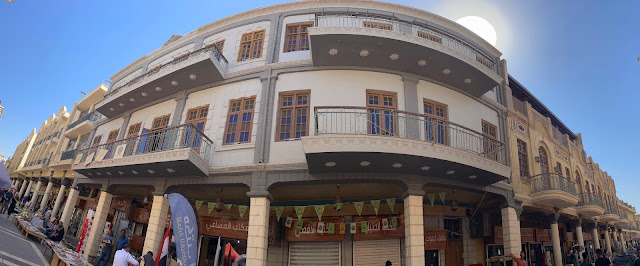
The Old Town is more “blown up” than old. The
US invasion took its toll on it but it continues to thrive. It does not have
that “old world feel” like Damascus and nowhere near the good looks and
atmosphere of Moroccan Souks but it does have people young and older who came
up to us to welcome us – probably the first tourists since COVID and the more
recent political unrest and demonstrations. In fact TODAY, 1 October
commemorates the revolution that eliminated the Royal Family back in 1958 and
was chosen by many as a day of demonstration against the government.
While we were sipping local chai tea and Iraqi
coffee in the Shabinder Café, opened in 1905 and the most famous in Baghdad, we
saw the demonstrations only a few kilometres away. Later, as we were returning
to the hotel we found out that the police started firing live rounds above the
crowd to disperse them and prevent them from advancing on the centre of the
city. Our guide told us that the demonstrations were aimed at the disinterest
of the current government to fix multiple problems including unreliable
electricity, garbage, blocked sewers and no social services. Our guide decided
to cut our tour short and return us to the hotel just in case things escalated.
Here we were in the middle of the action of a crying country…
The crowning moment came when we feasted on the
national dish of Iraq that night = MASGOUF which is freshwater carp – butterflied
and stuffed with fresh herbs, tomatoes and rock salt ad cooked over hot coals.
It is eaten all over Iraq but best in Baghdad. It is so popular and so Iraqi
that it was Saddam Hussein’s craving for masgouf — it was his favourite meal —
provided the vital clue needed for U.S. Army interrogators to track down the
dictator-in-hiding to a foxhole near the city of Tikrit !!! Masgouf brought
down a dictator !!!
Speaking of which, as we were eating we heard
several large “booms” that sounded like explosions. They were. Our guide turned
on the news on his phone and discovered that only 5km from our restaurant,
local civilian demonstrators had tried to storm the bridge that leads to
Parliament and the army fired rubber bullets and tear gas bombs to stop the crowd.
No one died but 100 were hospitalised. As we left the restaurant a long line of
Ford F350 military trucks supplied by USA sped passed with machine guns on the
back. We were not allowed to film them so I cannot bring this back to you but
there I was in the thick of it !!!
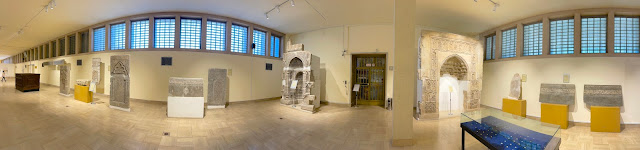
The following morning (2 October 2022) we
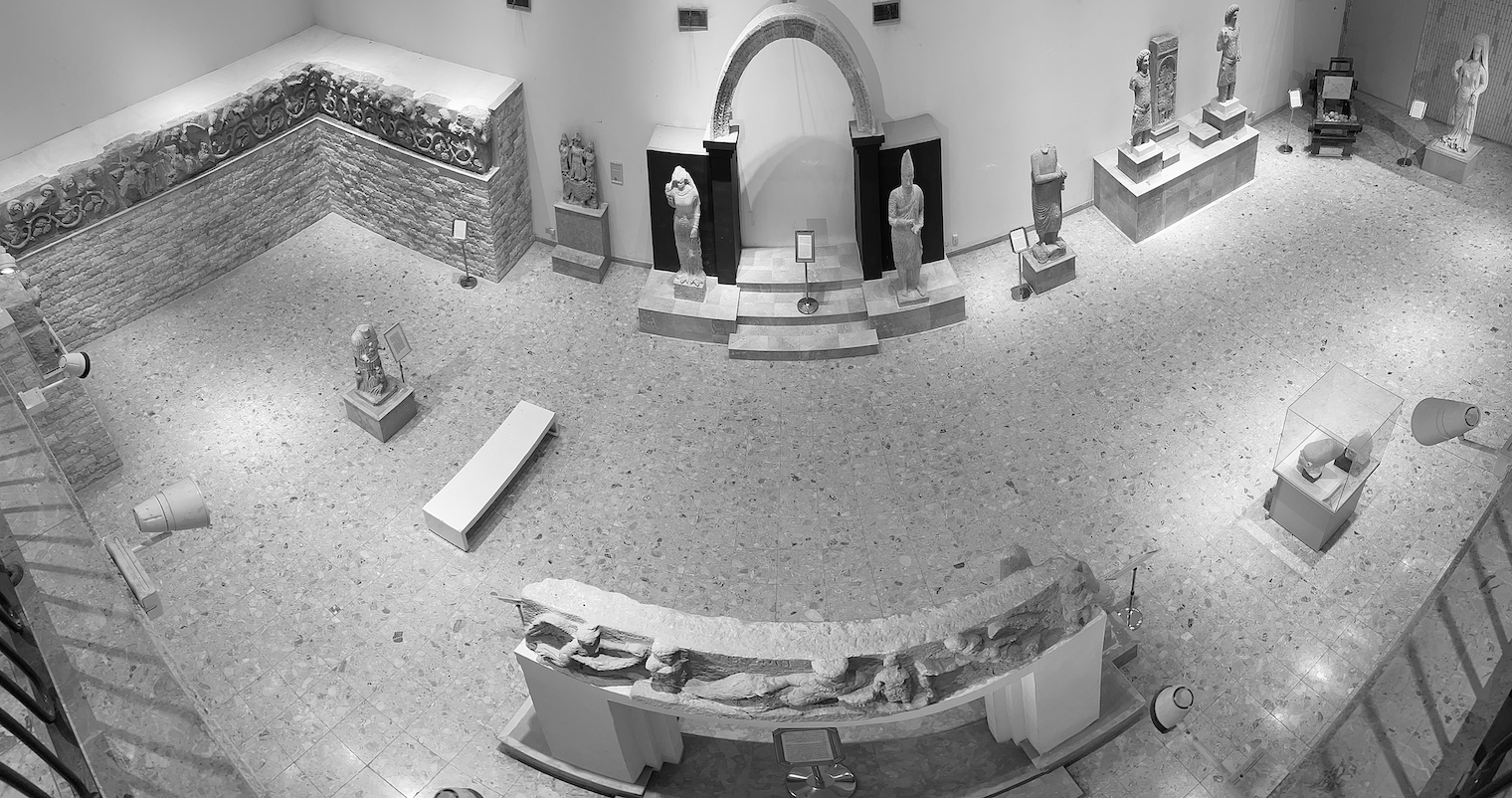
visited the Iraq Museum which we missed on the day before because of road
closures due to the demonstrations. This museum was opened in 1966 and luckily
was not damaged in the US Invasion but ISIS did lute it and stole or smashed
30-40% of total exhibits at the time. The museum was closed for years and only
recently opened. The exhibits that survived are extensive and very well
preserved and quite significant for Iraq. The following major civilisations
lived in Mesopotamia or what is now modern Iraq (in alphabetical order): Abbasids,
Akkadians, Arabs Assyrians, Greeks and Sumerians. These civilisations also
battled the Romans, Greeks, Persians, Parthians, Sasanians, Bedouins and
Ottomans. The Greeks built an entire city called Hatra and lived there
312-139BC. This is what makes Iraq such a magnet for the well-travelled who
love antiquity, culture and history. After our museum visit we finally left
Baghdad for Babylon to be covered in the next post.
In the meantime, enjoy Baghdad and enjoy the
fishy Masgouf…






ABOUT IRAQ:
Iraq (Pop 40,462,701, Highest Peak 3,611m , First
Settled 65000BC) is quite simply “The Cradle of Civilisation” in that the
Sumerian People first occupied Mesopotamia also known as “The Tigris-Euphrates
Rover Valley” which is in modern day Iraq. It was here, in the late 4th
millennium BC, that the world's first writing system and recorded history
itself were born. The Sumerians were also the first to harness the wheel and
create city states, and whose writings record the first evidence of
mathematics, astronomy, astrology, written law, medicine and organised
religion.
The next great civilization to emerge in the
land was the Babylonian Empire in the 1800s BC. The Babylonians would rise to
great power in the region until they were defeated and absorbed into the
Persian Empire led by Cyrus the Great in the 6th Century BC. Over the next
several hundreds of years the land would be conquered by various empires
including Greece (Alexander the Great), the Parthians, the Romans, and the
Persians again. In the 7th Century the Islamic Empire took control and would
rule until the 1500s when the Ottoman Empire came into power.
When World War I ended, the British took over
for the Ottoman Empire. Iraq became an independent country in 1932 ruled by a
constitutional monarchy. In 1958 the country was declared a republic, but it
was really ruled by a series of dictators. The last dictator was Saddam
Hussein.
In 1990 Iraq invaded the country of Kuwait.
This started the First Gulf War where US-led forces expelled Iraq and forced
Iraq to come under UN restrictions regarding weapons and armaments. In 2003,
when Iraq refused to comply to earlier agreements, the United States invaded
Iraq in what is called the Second Gulf War and removed Saddam Hussein from
power.
In January 2005, the first elections since the
invasion took place and in October a new Constitution was approved, which was
followed by parliamentary elections in December.
During 2006, fighting continued and reached its
highest levels of violence, more war crimes scandals were made public, Abu
Musab al-Zarqawi the leader of Al-Qaeda in Iraq was killed by US forces and
Iraq's former dictator Saddam Hussein was sentenced to death for crimes against
humanity and hanged.
In May 2007, Iraq's Parliament called on the
United States to set a timetable for withdrawal and US coalition partners such
as the UK and Denmark began withdrawing their forces from the country. The war
in Iraq has resulted in between 151,000 and 1.2 million Iraqis being killed.
The US began handing-over and puling-out in 2009 and completed their exit by
2011.
In 2012 and 2013, levels of violence increased
and armed groups inside Iraq were increasingly galvanised by the Syrian Civil
War. Both Sunnis and Shias crossed the border to fight in Syria. There has been
countless conflicts
between countless factions resulting in fixed
elections and a succession of Prime Ministers and Presidents. Given the Syrian
crisis has abated and with the advent of several factional fighters taking up
paid arms in Ukraine this has created a window of opportunity to visit this
vast and ancient country.
The other reason for a slow revival in tourism
is that the oil-rich country is now exporting oil again given the end of COVID
and the Syrian Crisis which in itself has created opportunities to sell oil to
countries under sanctions from the US. As a result unemployment is down to 10%
(a lot higher before) and this has a flow-on effect to tourism in a positive
way.
I shall be commenting further on Iraq as I
discover things for myself by talking to the ordinary people of Iraq.