Wednesday, October 5, 2022

POST FEATURE – IRAQ – AL-CHIBAYISH - BAGHDAD (4 October 2022, Day 5 covering 551km to 1,220km)

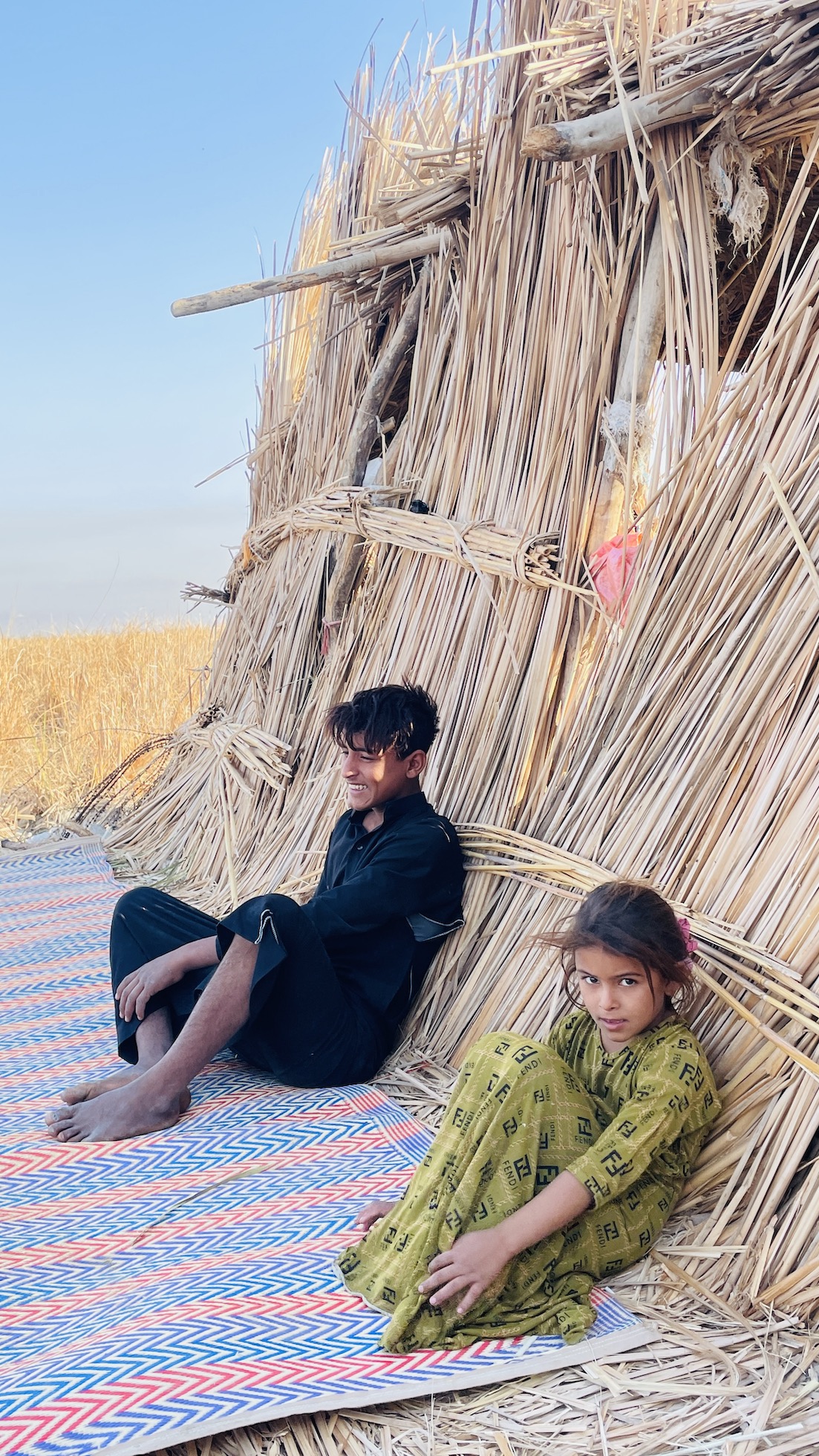
In this post we drive from Nasariyah to the town of Al-Chibayish in the Mesopotamian Marshes near where the Tigris Rover merges with the Euphrates River, take an extensive boat trip through the marshes, have brekkie on a reed house in the marshes, a local fish lunch back in the town of Al-Chibayish and then a long drive back to Baghdad.


Our 4am departure today was well worth it. Watching the sun rise over the desert and eventually seeing the calm waters of the Euphrates reflecting gold under the rising sun. We were met by four long boats in the small village of Al-Chibayish and began our 10km cruise into the maize of marshes to reach a family on a reed and mud island approx. 30min later.


The Mesopotamian Marshes, also known as the Iraqi Marshes, are technically a wetland area located on the floodplains of the Euphrates and Tigris rivers bound by the cities of Basra, Nasiriyah, Amarah and a portion of southwestern Iran. The unique wetland landscape is home to the Marsh people (Maʻdān in Arabic), descended from the Ur, Sumer and Babylon civilisations, who have developed a unique culture tightly coupled to the landscape – harvesting reeds and rice, fishing and herding water buffalo.


Draining of portions of the marshes began in the 1950s and continued through the 1970s to reclaim land for agriculture and oil exploration. In the late 1980s and 1990s, during the presidency of Saddam Hussein, this work was expanded and accelerated to evict Marsh people from the marshes. Half the population was displaced under Hussein. Before 2003, the marshes were drained to 10% of their original size. After the American overthrow of Hussein in 2003, the marshes have partially recovered but drought along with upstream dam construction and operation in Turkey, Syria and Iran have hindered the process. Originally the marshes covered a massive area of 35,572 square kilometres (half the size of Tasmania !!!) but now have been reduced to 9% of the original size but protected under 2016 UNESCO.


There are now 56 families living on the marshes in the Al-Chibayish area out of a total of 20,000 throughout the rest of Iraq and Iran around the Persian Gulf. The Maʻdān live inside domed and rectangular shaped dwellings made entirely of harvested reeds. A typical dwelling for a family of 4 takes husband and wife 12 days to build. The dwellings are renewed every few years since the reeds tend to rot with the heavy rain that comes in winter. Water Buffalo are not eaten but their milk is sold to make a special cream that Iraqis use for deserts. The buffalo poo is dried and used as fuel for fire to cook. There are also chickens and ducks that provide eggs and meat. Fish is also a staple. There are no veggies or fruit grown – these are purchased along with flour and water in exchange for buffalo milk and eggs in Al-Chibayish.


The family at our first stop kindly made us a brekkie of omelette, yogurt, sesame seed paste (tastes like vegemite) and sweet molasses (tastes like honey) all wrapped in thin circular pita-style bread they make themselves in round oven like vases made from the clay from the river bed – they look like Indian tandoors. The Maʻdān comprise 5 different tribes which all speak their own dialects of Arabic often referred to as Mesopotamian Arabic. They are all Muslims. Some tribes closer to the Persian Gulf also grow rice, barley and wheat since the conditions there support it. Children are mostly schooled by their parents but many our now sending their kids to schools in the closer small villages.


Our second stop was a family only 2km further downstream. This was more a rest and water stop and an opportunity to play with a larger group of children.


On our return to Al-Chibayish we were the guests of the lead boat driver named Abu Haider. This guy is a real character, always funny and very inviting. He put on a terrific catfish lunch and told us stories of the Karbala Battles. Abu Haider is in fact famous with tourists in the past and makes films that he puts on YouTube – check them out !!!


Before lunch I was fortunate to achieve one of my dreams in life – to swim 2km in Tigris or Euphrates Rivers where human civilisation was born !!! Abu Haider chaperoned me in his long boat as I made my way downstream towards the Persian Gulf. Only 40km ahead of me the Tigris meets the Euphrates that I was in and it is at this junction, that legend has it, was the location of THE GARDEN OF EDEN or Heaven or Paradise !!! Just think if it – I was swimming towards Heaven !!! The fresh water was a pleasant 25C, cloudy yellow with a very slimy muddy silt sea floor that you cannot stand on or you will sink like quicksand !!! I swam closer to the middle of the river where the depth reaches an average of 4 metres. Abu Haider was very impressed with my swim but he sailed so close to me that he filled my lungs with two-stroke from his outboard. Iran was only 70km ahead of me and Kuwait 120km where the Persian Gulf is located. Amazing that I got to “swim in Iraq” something I never imagined as I flew countless flights from Australia to Greece over this vast barren yellow desert landscape. I often think what would have happened with civilisations and history if the Tigris and Euphrates never existed – there is no doubt that these rivers are indeed “the rivers of life” !!!


It took us 5hrs to drive back to Baghdad to position us for our journey north towards the Kurds over the next few days. We made a stop at BAB AL-AGHA bakery which is the most famous bakery and sweet (pastry) shop not only in all of Baghdad but in all of Iraq. Just the incredibly beautiful smell of the hundreds of sweets is enough to make you full !!!


What a day – enjoy the Mesopotamian Marshes and the Garden of Eden…


Tuesday, October 4, 2022

POST FEATURE – IRAQ – AL KIFL – NAJAF – UR – NASARIJAH (3 October 2022, Day 4 covering 390km to 669km)

In this post we drive from Karbala to Nasariyah via: Al Kifl, Al Najaf & Ur. In this post I also visit the two huge shrines in Karbala first thin in the morning instead of with the group late the night before as I wanted to get my first Iraqi post to you and I prefer to photograph monuments during the day.


Karbala (Pop 690,100, Elev 28m, First Settled 690BC) is a Holy City for the Shia Muslims in the same way as Mecca, Medina and Jerusalem for the other Islamic faiths. Tens of millions of Shi'ite Muslims visit the site twice a year, rivalling Mecca and Mashhad by the number of pilgrims annually. Shia come here to from all over the world to visit two very important shrines: The Al Abbas Shrine and The Imam Husayn Shrine. Both shrines are spaced 800m apart and simply blew my mind. Huge shimmering glass covered ceilings dripping with myriads of chandeliers lighting up coloured wall mosaic tiles and impeccable patterned coloured carpets. I visited 0630-0715 and both places were teeming with people of all ages. Men and women worship in separate spaces and I was surprised at the number of toddlers and teenagers present – all here for blessings. Filming and snapping both shrines in just 45min so I could make it back to the hotel on time for an 8am departure was the toughest assignment in my travels so far because I had to check in my sandals and cameras (mobiles allowed), walk around two huge floor plans and negotiate my way through crowds to decide what to shoot. Photography and filming are not allowed but not strictly enforced since many faithful were taking selfies and photographing each other inside. A local asked me to photograph me and when he found out I was from Australia he was surprised and moved and spoke to the guards about me taking footage – Islam smiled on me that morning – the footage may turn out to be the highlight of this trip. Finally I jogged back to the hotel to make the bus.


ABOUT THE SHRINES:


The Imam Husayn Shrine is the mosque and burial site of Husayn ibn Ali, the third Imam of Shia Islam, in the city of Karbala. It stands on the site of the Mausoleum of Husayn, who was a grandson of Muhammad, near the place where he embraced martyrdom during the Battle of Karbala in 680AD. The shrine is the size of 2 football fields but the inner sanctuary is much smaller.


The Al-Abbas Shrine is the mosque and mausoleum of Abbas ibn Ali who was Husayn's flag-bearer in the Battle of Karbala and chief of his caravans. The shrine was started in 680AD with the burial of Al-Abbas after he was killed in the Battle of Karbala and covered with a grand mosque in 1622AD. It is almost the same size as the Imam Husayn Shrine. It has undergone several renovations since to accommodate the many millions who come here, most walk here !!!


Al Kifl (Pop 22,800, Elev 35m) is a town in south-eastern Iraq on the Euphrates River, between Najaf and Al Hillah. Kifl is the location of Al-Nukhailah Mosque, containing the tomb of Dhul-Kifl who is believed be the biblical Prophet Ezekiel. A project to renovate the tomb and develop it as a tourist attraction has proven controversial. The town was once a significant Jewish pilgrimage site and home to a community of Iraqi Jews until the late 1940s. We visited the tomb which is in a small chapel that dates back to the 15th Century. Why is a Jewish Prophet buried in Iraq? It is written that the Prophet Ezekiel died in ancient Babylonia and was therefor buried here. Many Jews still live here and pretend to be Muslim to stay close to their revered Prophet.


Najaf (Pop 1,389,500, Elev 60m) is home to Wadi-Us-Salaam, the largest cemetery in the world !!! It is mainly the preferred resting place of Shia Muslims. There are over 6 million bodies in this cemetery covering 6 square kilometres !!! The graves are very small and crowded to enable more people to be buried here. Departed Muslims are washed and taken to their local Mosque for prayers and then buried – all in the space of 24 hours or less. Each grave is dug to a depth of 7m (25 ft) to enable up to 12 family members to be buried. Muslims do not practice the southern European tradition of digging up the departed several years later to wash the bones and place them in a small space or add them to the coffin of a newly buried family member which is the practice in Greece. Sadly we did not get to visit the hill that overlooks the cemetery or the Imam Ali House (the very spot where Imam Ali was killed) or the Imam Ali Shrine because the military did not give us permission because the Supreme Shia Leader was in town at the same time and is constantly under threat of attack. Instead we climbed on top of the bus to get some deeper shots of this enormous cemetery. The Imam Ali Shrine is just as important to the Shia as the Imam Husayn Shrine in that it contains the remains of the first cousin and brother-in-law of The Prophet Mohammad. Legend also says that the remains of Adam and Noah are deep in the ground under the Shrine ! Amazing.


Our next stop of Ur is a whopping 250km away, almost at the southern tip of the country only 200km from Kuwait. We made a brief stop for lunch at Abu Sukair which is right on the Euphrates.


The “Ziggurat of Ur” is a huge ancient temple in the form of a step-pyramid near the village of Ur and the town of Nasariyah (our overnight stay). The 2016 UNESCO protected ziggurat was built by Sumerian King Ur-Nammu in the 21st century BC. It 4 m (210 ft) long, 45 m (148 ft) wide and over 30 m (98 ft) high. The ziggurat was a piece in a temple complex that served as an administrative centre for the city, and which was a shrine of the moon god Nanna, the patron deity of Ur.

Nasariyah (Pop 558,400, Elev 38m, Est 1872) is only 15min? drive from the Ziggurat and was a welcomed site after such a long day. Nasiriyah is on the lower Euphrates, about 360 km (225 miles) south-southeast of Baghdad. It had a diverse population of Muslims, Mandaeans and Jews in the early 20th century but today its inhabitants are predominantly Shia Muslims. Nasiriyah is the centre of the date-growing area. The city's cottage industries include boat-building, carpentry and silver working. The city museum has a large collection of Sumerian, Assyrian, Babylonian, and Abbasid artifacts. The Euphrates merges with the Tigris for the final time about 10 kilometres from the city where legend has it that the Garden of Eden (Paradise or Heaven) was located even though there are no tourist sites to say so. In any case this area is quite the opposite to Heaven with dry near 40C heat and nothing but flat yellow sandy desert.

 My Heaven was back in the hotel in Nasariyah with a cold bottle of Lebanese dry white wine…

THE TOMB OF THE PROPHET EZEKIEL


THE TOMB OF THE PROPHET EZEKIEL